No. 50War memorialWest end
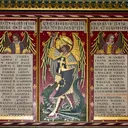
Second World War Memorial
1939–1945
The inscription
Men of The Parish of St Michaels, Malton who gave their lives in the second world war 1939-1945.
The names
- J E HargreavesPte
- C F HudsonL.A.C. – R.A.F.
- B F HudsonSergt. R.A.F.
- J O LaverackP. Officer R.A.F.
- P G W LeefeP. Officer R.A.F.
- G LotheringtonL.A.C. R.A.F.
- T G MennellL.Sea. R.N.
- J A SpenceCpl. R.A.F.
- C StancliffeSergt. R.A.F.
- D C R WalkerW/Cmdr. R.A.F.
Although there are 20 Malton men commemorated on the Town War Memorial, there are only 10 mentioned here.
Private John Eric Hargreaves
Private John Eric Hargreaves of the 5th Battalion, Green Howards Regiment died on 24 May 1940 age 21. He died defending the town of Arras, as the German Army overran the Low Countries and invaded France. This type of rear-guard action slowed the German advance and enabled more troops to reach the beaches of Dunkirk. The evacuation of the British Expeditionary Force began on 26th May 1940, 2 days after his death. Hargreaves’ body was retrieved by locals and is buried at Bug Cemetery, Belgium.
Leading Aircraftman Christopher Forge Hudson
Leading Aircraftman Christopher Forge Hudson of the Royal Air Force 220 Squadron died on 1st January 1940 age 28. At the time of his death he was the Wireless Operator and Air Gunner flying on a North Sea reconnaissance mission. The crew intercepted a German bomber off St Abbs Head, Berwick, but in the ensuing fight both badly damaged aircraft crashed into the sea. No bodies were recovered. Hudson is commemorated at the Runnymede Memorial, Surrey, which is for RAF personnel lost in Western Europe with no known resting place.
Flight Sergeant Benjamin Johnson Hudson
Flight Sergeant Benjamin Johnson Hudson served in 576 Squadron of the Royal Air Force. He was acting as a Wireless Operator and Air Gunner on his final flight. He died on 16th May 1944 (age 21) while on a mission laying mines in the Baltic Sea between Denmark and Germany. The aircraft was shot down over the occupied Danish island of Fyn. The Germans buried the remains of the crew at Assens New Cemetery, Fyn. Six years later, on 16th May 1950, the local people dedicated a memorial to the crew at Gamtofte, near the crash site.
Pilot Officer John Owen Laverack
Pilot Officer John Owen Laverack served with 517 Squadron, a unit dedicated to meteorological reconnaissance. He died on 2 October 1945, age 29, while on a mission over the Atlantic. Communications to the plane were lost without warning and it is thought that the plane crashed due to catastrophic structural failure. The crew had reported concerns about a bang and vibrations during their previous flight but the ground crew had failed to find any damage. He is also commemorated at the Runnymede Memorial.
Flying Officer Geoffrey Willis (Peter) Leefe
Flying Officer Geoffrey Willis (Peter) Leefe served with 24th Squadron. At the time of his death, in the run-up to the D-Day Landings, his squadron was involved in keeping Allied global command lines connected through Gibraltar, North Africa and the Middle East. Leefe died at Gambut Base (Libya) on 7 April 1944 (aged 34) in a motor accident while supporting the ground crew. He is commemorated at Ramleh War Cemetery in central Israel.
Leading Aircraftman George Lotherington
Leading Aircraftman George Lotherington served in the Royal Air Force Operational Training Unit no. 54, which trained night fighter crews. At the time of his death he was based at RAF Chartwell, Scotland and was working on the ground as a Flight Mechanic. On 14th June 1943 a heavily armed aircraft got out of control as it was about to take off. Unfortunately, it crashed into another aircraft which was being refuelled by Lotherington. There was an enormous explosion killing him instantly. His body was returned to his wife for burial in Malton. He was 28.
Leading Seaman Thomas Godfrey Lyndhurst Mennell
Leading Seaman Thomas Godfrey Lyndhurst Mennell (Godfrey) was in the Royal Navy. He was land based and stationed at HMS Assegai, near Durban in South Africa. HMS Assegai was a major training and transit camp for the region. Mennell died of an illness on 10th March 1945 age 38 and was buried at Stellawood Cemetery, Durban.
Corporal Joseph Alban Spence
Corporal Joseph Alban Spence served in the Royal Air Force with No. 10 (Observer) Advanced Flying Unit in Dumfries, Scotland. This unit trained navigators and bomb aimers for active combat over Europe. In June 1942 there was a rare heatwave, and Spence died of heat stroke on 22nd June 1942 after being on duty, sitting on a concrete block in intense sunshine the day before. He was 21. His death was registered in Malton and his body was returned there for burial.
Sergeant Cecil Stancliffe
Sergeant Cecil Stancliffe served with the Royal Air Force 49th Squadron. On his final mission he was acting as Wireless Operator and Air Gunner. He died on 18 August 1943 (age 23) during Operation Peenemünde. This was a dangerous operation, flown at low altitude in bright moonlight. Its mission was to damage Germany’s secret V-weapon research facility, which British Intelligence had identified on the German Baltic coast. His plane was shot down on its return flight, over the Danish island of Als. His body was never recovered and so he is remembered at the Runnymede Memorial. Sixty years after the crash the local people erected a memorial to the whole crew at Holm on the island of Als.
Wing Commander Donald Cecil Broadbent Walker
Wing Commander Donald Cecil Broadbent Walker served in the Royal Air Force and was Wing Commander of 544 Squadron. This was an elite squadron specialising in high-altitude photographic reconnaissance. He died on 11th November 1943 (age 28) on a mission over Modane in the South of France. Anti-aircraft fire damaged the plane’s starboard engine, and during the flight towards Gibraltar the engines failed completely. The co-pilot bailed out successfully and survived, but the Wing Commander’s ’chute caught on the tail of the plane. The plane subsequently crashed in the Pyrenees, where local villagers recovered his body and buried him in their local cemetery in Peña, Navarre, Spain.
Connected memorials
Sources & further reading
Record status: Researched